The Dollar Premium People Actually Paid
Black-market USD rates, reserves, and policy pressure in Maldives.
grievances
money
policy
Maldives
A fact-based, people-first look at Maldives black-market USD rates, reserve currency/deposits, card-access limits, foreign-currency rules, and official reserve pressure.
This post uses a cleaned consolidated Viber, WhatsApp, and Telegram group-post series. One isolated 18.00 observation on 22 Apr 2026 was removed because surrounding values were near 20.00-20.10. The series is a market signal, not an official transaction record.
Main read
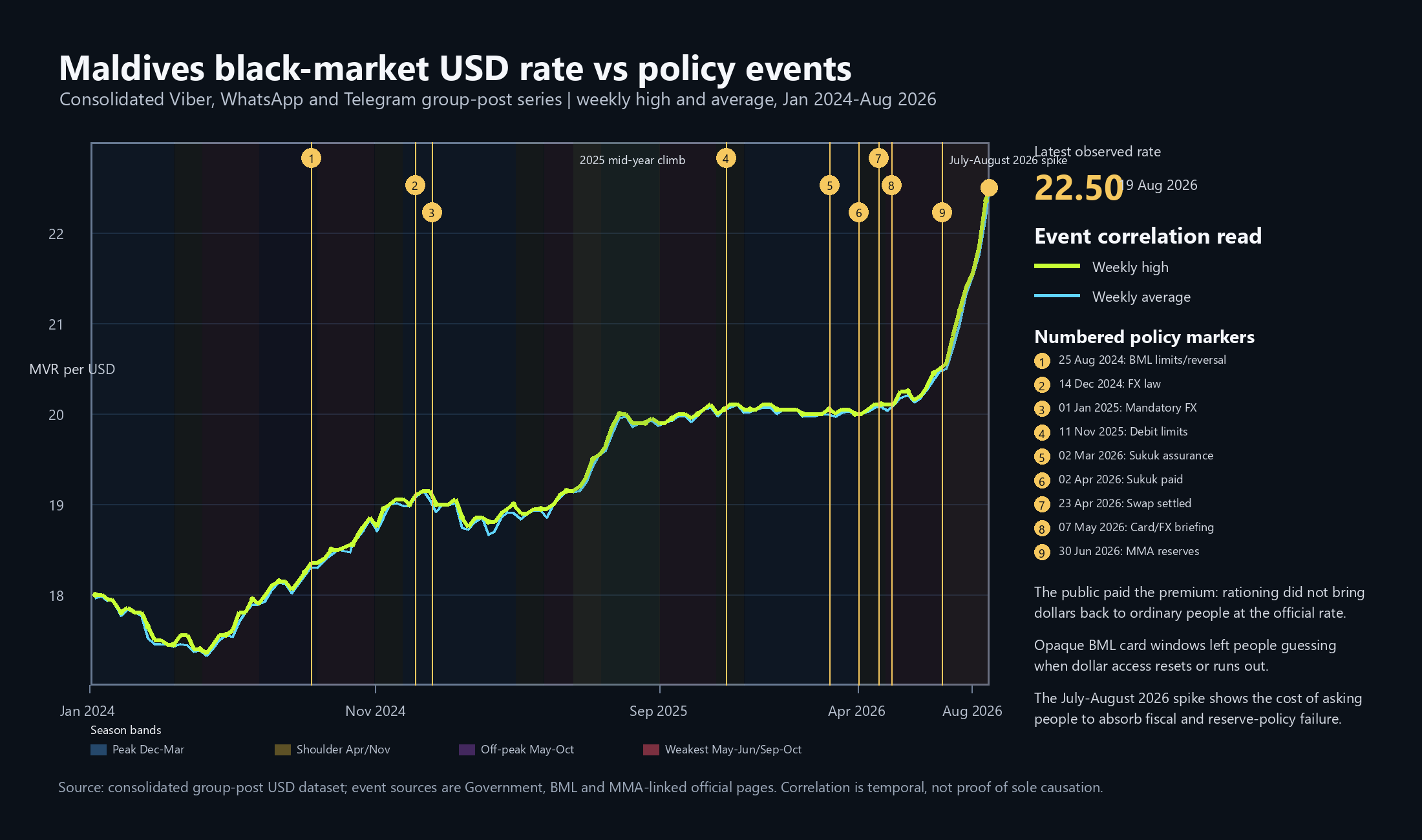
The cleaned series starts near 17.90 MVR per USD in January 2024 and reaches 22.50 by 19 August 2026. The fact that matters for the public is simple: people who could not access dollars through official channels faced a rising parallel-market price.
This is not a claim that one announcement caused one exact daily move. It is a claim that the policy mix failed its public test. Card limits, mandatory foreign-currency rules, debt and reserve messaging, and later BML access measures did not visibly normalize the black-market premium.
Reserves vs black-market rate
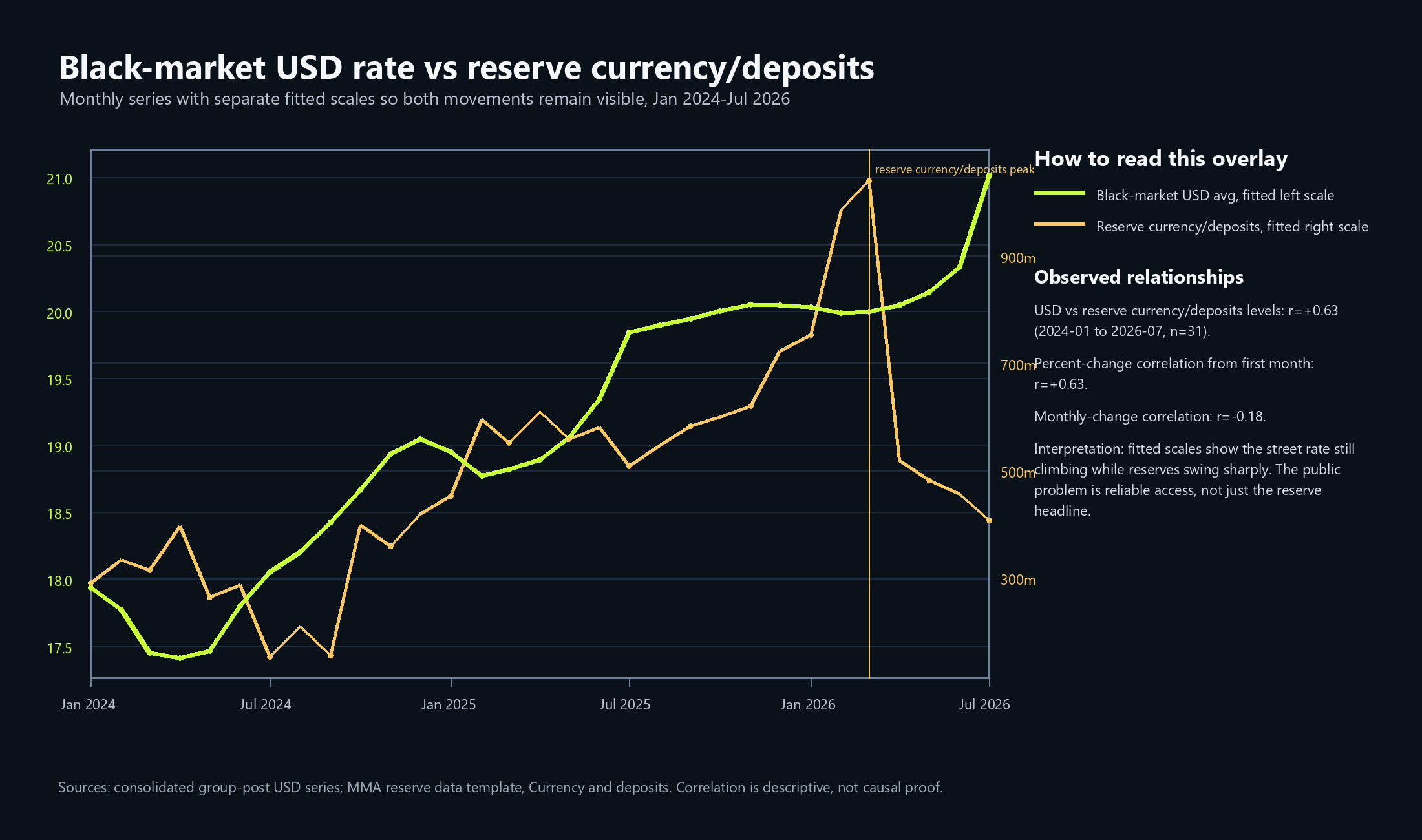
The line chart uses fitted scales so the black-market rate does not get flattened by the much larger reserve series. The hover text shows percent change from the first month for both the black-market USD rate and official reserve currency/deposits.
NoteCorrelation read
Across the full overlap, the level correlation is r = +0.63. That is a moderate positive relationship, but it is not a comforting result for policymakers. It mainly says reserves and the black-market rate were both elevated during the same broad period.
The month-to-month correlation is r = -0.18, which is weak and slightly negative. That means monthly reserve changes did not reliably move with monthly black-market changes. In plain language: higher headline reserves did not consistently translate into a lower street rate.
The most important break is March-July 2026. Reserve currency/deposits fell sharply after the March peak, while the black-market rate kept moving up. For ordinary people, that later window is the practical story: headline reserves did not mean reliable card access.
Weekly USD candles
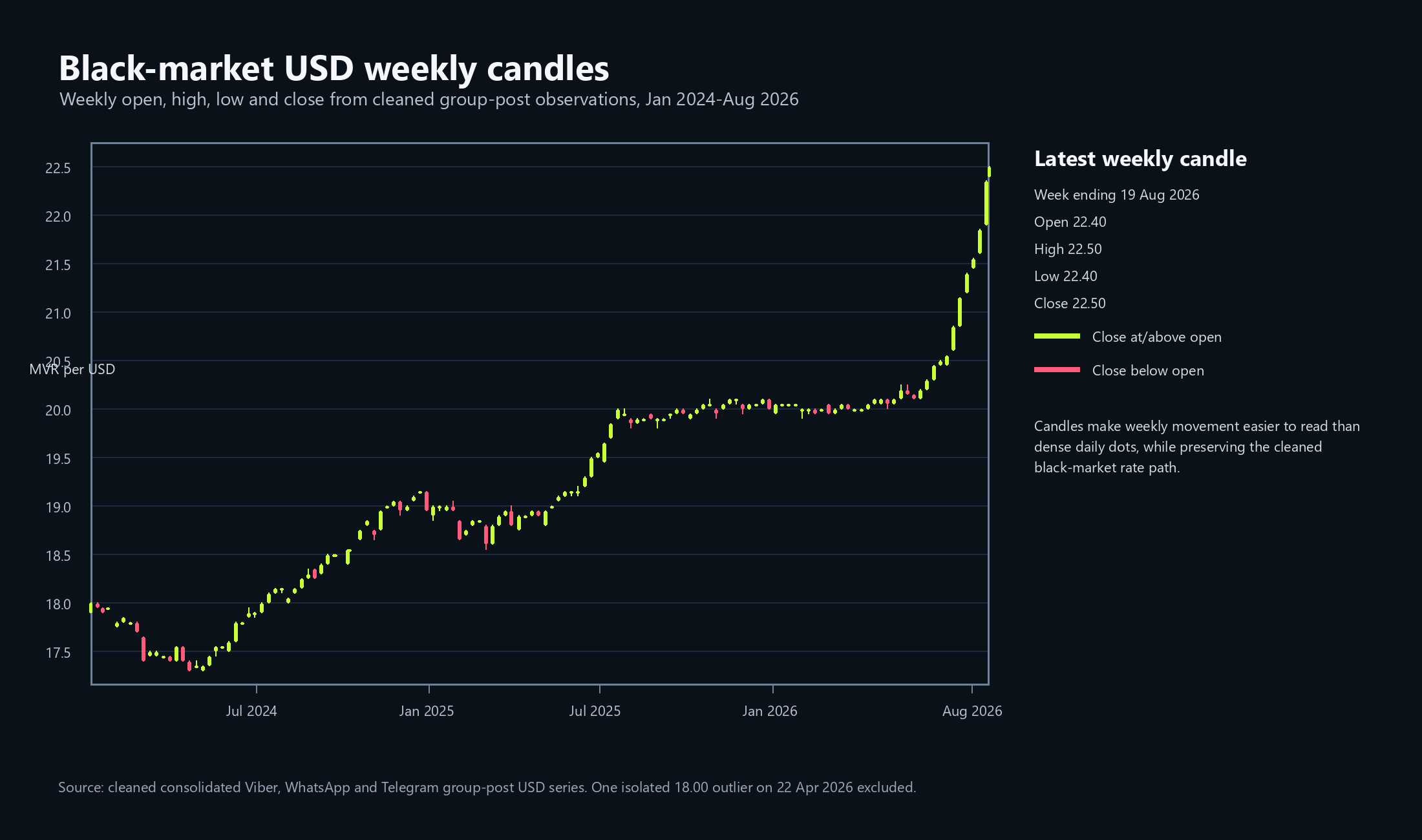
The candle view is separate on purpose. It keeps the USD series readable without mixing reserves into the same movement view.
Policy pressure points
| Date | Event | 14d | 30d | Read |
|---|---|---|---|---|
| 2024-08-25 | BML introduces severe foreign-card limits | +0.25 | +0.35 | strong temporal correlation |
| 2024-08-25 | BML reverses card-limit changes after MMA instruction | +0.25 | +0.35 | strong temporal correlation |
| 2024-12-14 | Foreign Currency Bill ratified | +0.00 | +0.00 | weak/no visible correlation |
| 2025-01-01 | Mandatory exchange framework begins | -0.15 | -0.50 | strong temporal correlation |
| 2025-02-07 | Government announces debt-and-reserve policy direction | -0.15 | -0.20 | moderate temporal correlation |
| 2025-11-11 | BML changes debit-card foreign transaction limits | +0.05 | +0.05 | weak/no visible correlation |
| 2026-02-06 | Government states official reserve and sukuk strategy | -0.05 | -0.05 | weak/no visible correlation |
| 2026-03-02 | Government says reserves available for sukuk payment | +0.05 | +0.00 | weak/no visible correlation |
| 2026-04-02 | Government clears April sukuk payment | +0.05 | +0.00 | weak/no visible correlation |
| 2026-04-23 | MMA settles USD 400m swap obligation | +0.05 | +0.10 | weak/no visible correlation |
| 2026-05-02 | BML announces measures for fair access to foreign currency | +0.10 | +0.00 | weak/no visible correlation |
| 2026-05-07 | Government explains BML card and FX access changes | +0.15 | +0.10 | moderate temporal correlation |
| 2026-06-30 | MMA reserve data marker remains a policy pressure point | +0.70 | +1.25 | strong temporal correlation |
| 2026-07-30 | BML reports foreign-currency access pressures in H1 update | +1.25 | +1.50 | strong temporal correlation |
The strongest public-interest point is BML access opacity. A card limit is already rationing. A practical daily card window that people cannot see, plan around, or verify is worse. It pushes households and small businesses into uncertainty while the parallel seller offers something the official system does not: a clear price and immediate access.
Government and BML can describe these measures as stability, fairness, or reserve management. The public test is more basic: can a person paid in rufiyaa reliably make a legitimate foreign payment at the official rate? The black-market premium says many could not.
Seasonality caveat
Resort season matters. Peak season is December-March, shoulder season is April and November, and off-peak season is May-October, with May-June and September-October often weaker. But predictable seasonal weakness does not excuse opaque access rules. If the weak months are known, the policy failure is preparation and communication.
What this can and cannot prove
This post can show timing, correlations, and pressure channels. It can say that the black-market rate moved in the same broad period as official FX, debt, reserve, and banking decisions. It cannot prove that any single policy caused a specific daily price.
The fact-based conclusion is still damaging for the government: official management protected the appearance of control better than it protected ordinary people from the premium.
Sources
- Bank of Maldives card-limit announcement
- Bank of Maldives reversal notice
- Foreign Currency Bill ratification, President’s Office
- Bank of Maldives mandatory exchange information
- BML measures for fair access to foreign currency
- Government briefing on BML foreign currency access changes
- MMA reserve database
- BML H1 2026 update